Living in Karlsruhe as a Student
Short answer
Karlsruhe is a mild, fan-shaped student city founded in 1715; its largest university, KIT, regained University of Excellence status in March 2026. A room in a shared flat averaged €526 a month in 2025 and residences house about 12 % of students. Non-EU students in Baden-Württemberg pay €1,500 tuition per semester.
Karlsruhe
Karlsruhe is known in Germany as the “Fächerstadt”, the fan city. In 1715 Margrave Karl Wilhelm wanted a summer residence and, legend has it, inspired by a dream he laid out a city shaped like a fan, with a baroque palace at its centre that is still the heart of Karlsruhe today. It is even said that Thomas Jefferson was so taken with the plan that he sent it to Pierre L’Enfant, who was designing Washington, D.C.
Apart from its plan, what I like most is that it is one of the warmest cities in Germany. Like Freiburg, Karlsruhe has a much milder climate than most of the country, and being so close to France shows on the table too: here you taste dishes, vegetables and sauces you rarely find elsewhere in Germany.
With about 37,000 students, Karlsruhe is a real student city. It is best known for its many technical programmes, it is a manageable size, and daily life is shaped around students, with plenty of cinemas, clubs and bars. Being some distance from the big cities is probably one reason why.

Karlsruhe city centre
Karlsruhe has seven higher-education institutions. The largest is the Karlsruhe Institute of Technology (KIT), which regained its University of Excellence status in March 2026. Engineering dominates, but you can also study social sciences and the arts. Many companies here work in communications technology and IT, so IT professionals are everywhere (which is where my own interest comes from).
Student housing in Karlsruhe
The campuses are all close to the centre, mostly between Innenstadt-West, west of the centre, and the eastern side where KIT is. That makes this area students’ first choice: a short walk to campus and town, with handsome old buildings and plenty of green space. Thanks to its plan and size, almost everything is quickly reached by bike; Karlsruhe competes with Münster for the title of Germany’s cycling city. Buses and trams are convenient too.
Rents are close to the German average, but as in many university cities, finding something affordable has been hard for years. Looking for a room in a shared flat is usually wiser than looking for a flat of your own; my article on student accommodation in Germany explains how.
An important reminder
Housing will be your biggest problem on arrival, so sort it out before you go if you can. To rent you need a bank account for the SEPA direct debit; to open a bank account you need a registered address; to register an address you need a “Wohnungsgeberbestätigung” from your landlord. A vicious circle. Some serviced apartments issue this confirmation for stays of 30 days or more: as soon as your dates are clear (if not, plan for a week before term starts), book one with free cancellation, and ask in writing beforehand whether they issue the confirmation. Then book an appointment at the Karlsruhe citizens’ office for a day or two after you arrive; at the start of term appointments can be up to 20 days out.
The Studierendenwerk Karlsruhe offers 2,160 residence places; with other providers the city has 4,371, enough for only about 12 % of students (1 January 2025). Residences are cheap and popular, waiting lists are long: apply early and be prepared to wait a semester or two. Good suburban connections also make living a little outside the city a realistic option.
| Type of housing | Monthly average (2025) |
|---|---|
| Room in a shared flat (WG) | €526 |
| 30 m² student flat, warm rent | €570 |
| German average for a WG room | €505 |
Source: MLP Studentenwohnreport 2025
Neureut in the north and Durlach in the east offer the most choice and the lowest rents, though they are further from the centre. Innenstadt-West is pricier because it is so close to the universities, but if a flat of your own is not your first priority it is worth a look.
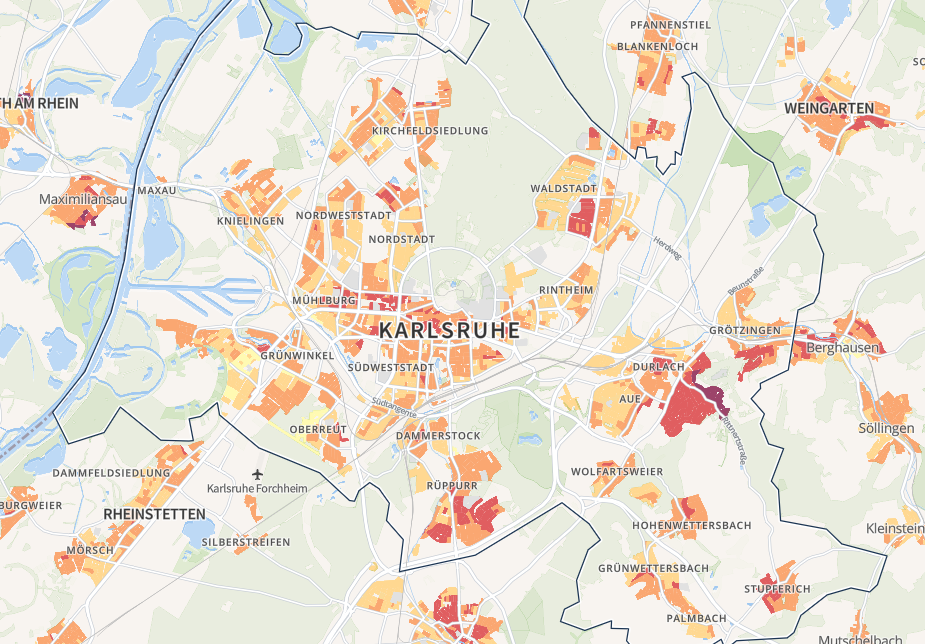
Rent levels by district (an older map; darker means more expensive)
Private residences
Besides the Studierendenwerk there are many private residences, some backed by churches or associations, some commercial. Sponsored ones are cheap but hard to get into; commercial ones cost more, so your chances are better. A few examples: Hans-Dickmann-Kolleg, Hans-Freudenberg-Kolleg, Augustin-Bea-Haus, Schwabenhaus e.V., YOUNIQ Karlsruhe.
How students spend their time
There is no single student quarter; you meet students in groups all over the centre. By day Kaiserstraße is the place for walking and shopping, alongside the ZKM Centre for Art and Media and the Natural History Museum. Barbecues and sport in the palace gardens are popular, and the student-run Unifest on the KIT campus and the “Das Fest” music festival every summer in the Günther-Klotz-Anlage are always packed.
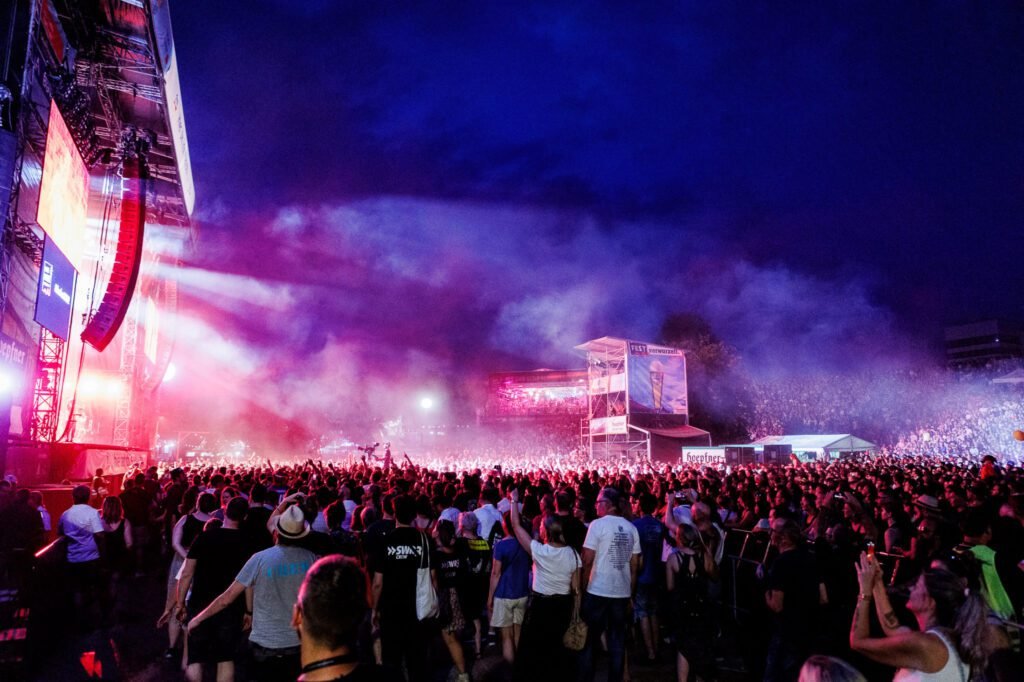
Das Fest
Estimated monthly cost of living (2026)
A rough monthly budget for a student sharing a flat in this city. A flat of your own, a car or frequent travel will push it up noticeably.
| Item | Monthly | Note |
|---|---|---|
| Rent (room in a shared flat) | €526 | Average WG room, MLP 2025 |
| Food | €235 | 2021 student average €198, adjusted for price rises |
| Health insurance | €145 | Statutory student rate €141–146 (2026) |
| Transport | €38 | Deutschlandsemesterticket €226.80 per semester; usually part of the semester fee |
| Phone and internet | €35 | 2021 average €31 |
| Clothing and personal items | €55 | 2021 average €46 |
| Leisure, culture, sport | €75 | 2021 average €65 |
| Tuition (non-EU students) | €250 | Baden-Württemberg: €1,500 per semester |
| Total | about €1,360 |
For the visa you must prove €11,904 a year (€992 a month); the usual way is a blocked account. If your budget is higher, family support or a student job has to cover the difference.
Sources: MLP Studentenwohnreport 2025, 22. Sozialerhebung (2021), Destatis consumer prices, Make it in Germany – proof of finances
Karlsruhe in numbers
| Students (winter 2024/25) | 36,857 |
| Residence places (total / Studierendenwerk) | 4,371 / 2,160 |
| Share of students housed | about 12 % |
Source: Deutsches Studierendenwerk, Wohnraumstatistik 2025
What can you study in Karlsruhe?
- Hochschulkompass: every programme at German public and state-recognised universities; choose “Karlsruhe” as the city.
- DAAD programme search: especially for programmes taught in English.
Sources
- Deutsches Studierendenwerk – Wohnraumstatistik 2025
- MLP Studentenwohnreport 2025
- Deutsches Studierendenwerk – 22. Sozialerhebung (2021)
- Forschung & Lehre – Universities of Excellence 2026
- Baden-Württemberg – Uluslararası öğrenci harçları
- Techniker Krankenkasse – Student contribution 2026
This article contains no partner links.

In case you wonder who I am: I am a parent who walked this path with his son and who sees himself as a guide. About →