Studying in Erlangen or Nuremberg
Short answer
Erlangen is the home of FAU; the city of 117,000 has more than 30,000 students. Because residences house only about 11 % of them, many students live in Nuremberg, 16 km away, where a room in a shared flat averaged €535 a month in 2025.
Erlangen
Welcome to Germany’s Manhattan. Not because of skyscrapers (buildings are mostly three storeys) but because of its grid of streets crossing at right angles. I have not been there yet, but I have heard and read a lot. The streets look so alike that occasional visitors easily get lost.
Erlangen is not big: about 117,000 people live here, more than 30,000 of them students, a typical student city. The region’s big university is the Friedrich-Alexander-Universität Erlangen-Nürnberg (FAU), founded in 1743. Being only 16 km from Nuremberg (about 20 minutes by public transport), Erlangen has not grown much; FAU’s campus reaches into Nuremberg, and the new Technical University of Nuremberg (UTN), founded in 2021, adds momentum to the region.
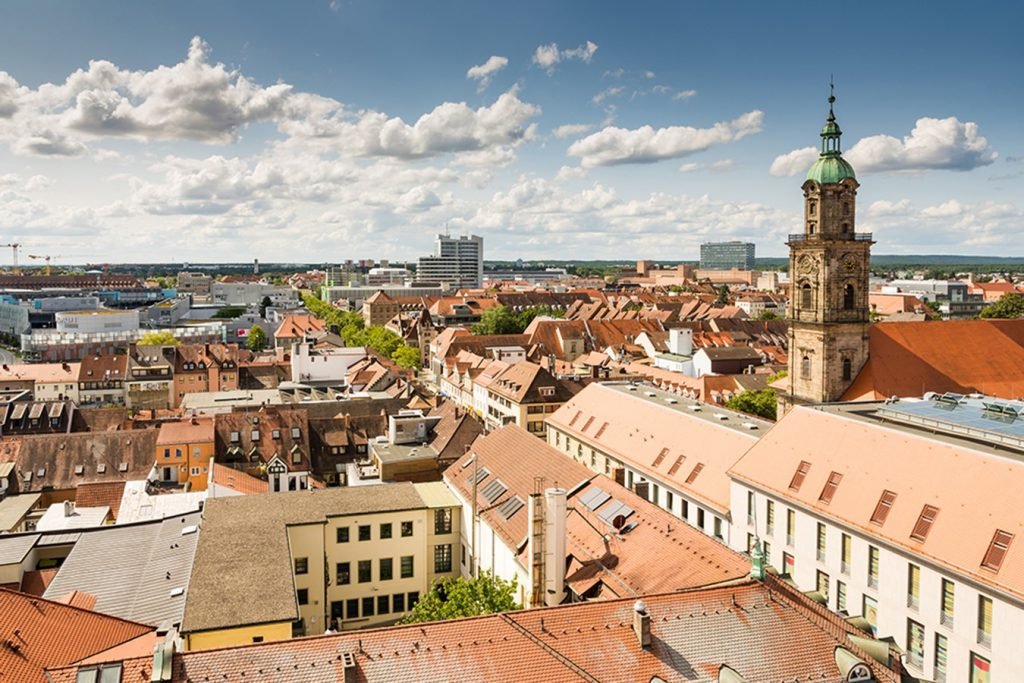
Nuremberg and Erlangen are in Franconia, part of Bavaria, and locals are proud to call themselves Franconians rather than Bavarians; regional identities run deep in Germany. The area is highly industrialised, with Siemens, Bosch and DATEV, and Nuremberg’s U3 was Germany’s first driverless metro line.
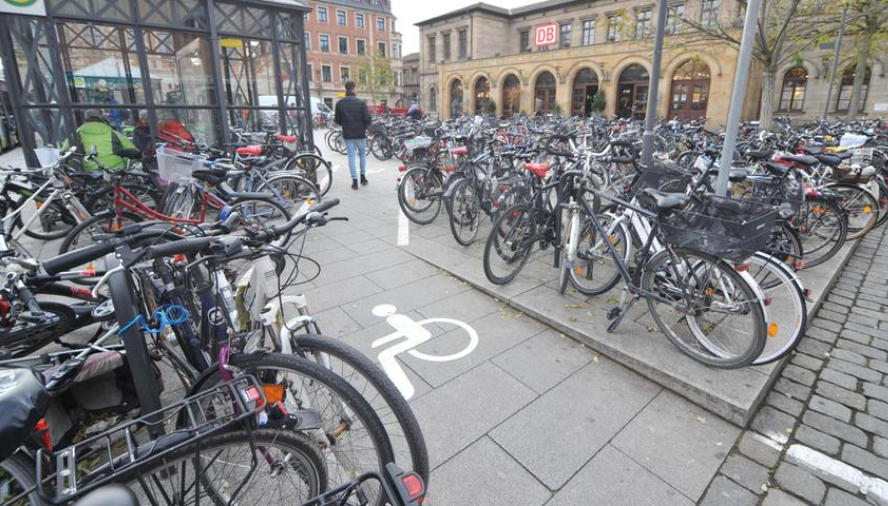
In front of Erlangen station
With its flat terrain and excellent cycle network, Erlangen is a cycling city: mountains of bikes pile up in front of every public building, above all the university. For drivers it is the opposite: scarce and expensive parking, one-way streets and many traffic lights. (It reminded me of Amsterdam.)
Living in Erlangen and Nuremberg
With so many students and few alternatives, rents are high and residences are scarce: Erlangen’s 3,322 residence places house only about 11 % of students (1 January 2025). That is why many students live in Nuremberg. The 2025 MLP rent report does not list Erlangen separately; Nuremberg’s figures are a good guide for the region:
| Type of housing | Monthly average (2025) |
|---|---|
| Room in a shared flat (WG) | €535 |
| 30 m² student flat, warm rent | €558 |
| German average for a WG room | €505 |
Source: MLP Studentenwohnreport 2025
Students choose Nuremberg mainly for its social life and the much wider choice of flats. The Studierendenwerk Erlangen-Nürnberg (werkswelt) offers more than 3,200 places in the two cities; with other providers there are 3,322 in Erlangen and 1,850 in Nuremberg, where residences house only about 7 % of students. Apply early: Studierendenwerk Erlangen-Nürnberg residences.
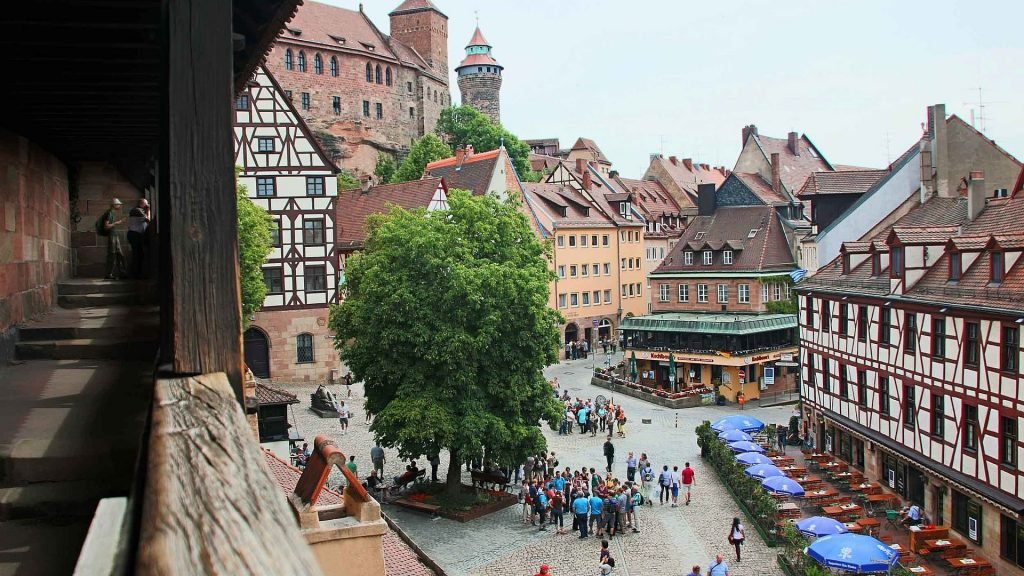
Altstadt – Nuremberg
Estimated monthly cost of living (2026)
A rough monthly budget for a student sharing a flat in this city. A flat of your own, a car or frequent travel will push it up noticeably.
| Item | Monthly | Note |
|---|---|---|
| Rent (room in a shared flat) | €535 | Erlangen is not in the report; neighbouring Nürnberg, MLP 2025 |
| Food | €235 | 2021 student average €198, adjusted for price rises |
| Health insurance | €145 | Statutory student rate €141–146 (2026) |
| Transport | €38 | Deutschlandsemesterticket €226.80 per semester; usually part of the semester fee |
| Phone and internet | €35 | 2021 average €31 |
| Clothing and personal items | €55 | 2021 average €46 |
| Leisure, culture, sport | €75 | 2021 average €65 |
| Total | about €1,120 |
For the visa you must prove €11,904 a year (€992 a month); the usual way is a blocked account. If your budget is higher, family support or a student job has to cover the difference.
Sources: MLP Studentenwohnreport 2025, 22. Sozialerhebung (2021), Destatis consumer prices, Make it in Germany – proof of finances
Erlangen in numbers
| Students (winter 2024/25) | 30,562 |
| Residence places (total / Studierendenwerk) | 3,322 / 2,146 |
| Share of students housed | about 11 % |
Source: Deutsches Studierendenwerk, Wohnraumstatistik 2025
What can you study in Erlangen?
- Hochschulkompass: every programme at German public and state-recognised universities; choose “Erlangen” as the city.
- DAAD programme search: especially for programmes taught in English.
Sources
- Deutsches Studierendenwerk – Wohnraumstatistik 2025
- MLP Studentenwohnreport 2025
- Deutsches Studierendenwerk – 22. Sozialerhebung (2021)
- Techniker Krankenkasse – Student contribution 2026
This article contains no partner links.

In case you wonder who I am: I am a parent who walked this path with his son and who sees himself as a guide. About →