Studying in Duisburg: Europe’s Largest Inland Port
Short answer
Duisburg, where the Rhine and the Ruhr meet, is an industrial city with Europe’s largest inland port and one of the campuses of the University of Duisburg-Essen. Ruhr-area rents are well below the German average; residences house about 7 % of students.
Duisburg
Duisburg, where the Rhine and the Ruhr meet, made its fortune with steel and coal. Today its people enjoy green parks, wide meadows and a bit of nostalgia. It is an ideal place to get to know German industrial history and culture.
Arriving by train, your first impression of the main station square may not be great; I had been warned not to judge too quickly. A few minutes away you find the Inner Harbour, where you will think “this is the real city”. Old warehouses around the basin have been modernised and joined by new buildings, with offices, shops and restaurants whose terraces fill up on summer evenings.
A summer walk in the Landscape Park Duisburg-Nord is a must. This former industrial complex, with its blast furnaces, halls and huge machines, has been turned into a green park; you can feel as if you are in a science-fiction film. In the evening the site is lit in changing colours (I did not see it at night, but I am sure it is beautiful).
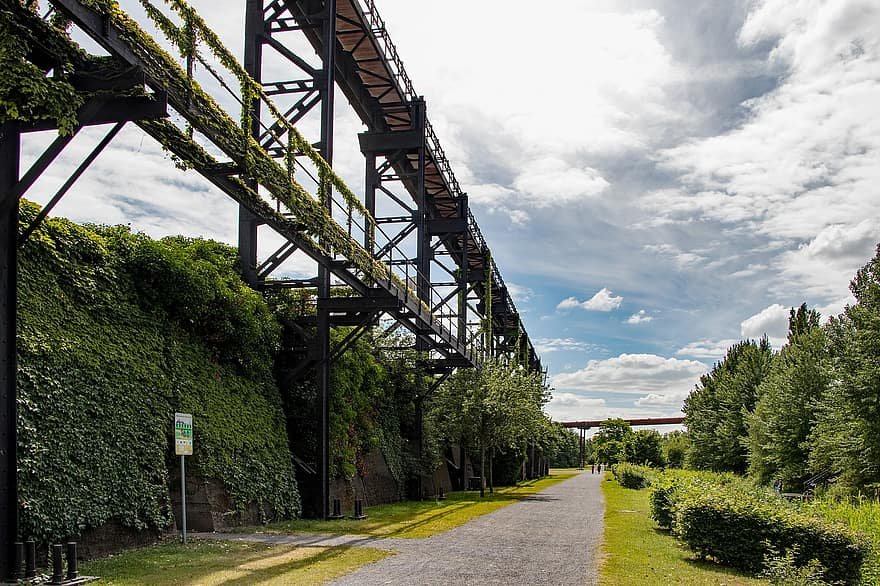
Landscape Park Duisburg-Nord
Duisburg is home to Europe’s largest inland port. After the steel crisis of the 1970s many plants closed, and the city has been reinventing itself ever since.
If you get the chance, visit Weseler Straße in Marxloh: with its bridal boutiques and jewellers it has become Germany’s wedding-dress capital, and couples even come from the Netherlands, Belgium and France. It reminded me of home 🙂
Student life and rents in Duisburg
Duisburg is home to one of the two campuses of the University of Duisburg-Essen. In some programmes you may have classes in both Duisburg and Essen; the train takes about half an hour and the semester ticket covers regional trains. The university is a member of the University Alliance Ruhr with Bochum and Dortmund.
Compared with Essen and Düsseldorf, you can find larger flats for less money in Duisburg, and you are close to Düsseldorf, Cologne, Essen and the Netherlands.
The 2025 MLP rent report does not cover Duisburg. For orientation, figures from the same report:
| Comparison | WG room, monthly average (2025) |
|---|---|
| Bochum (Ruhr area) | €322 |
| Düsseldorf | €517 |
| German average | €505 |
Source: MLP Studentenwohnreport 2025
Rents in the Ruhr area are clearly below the German average, and Duisburg is no exception. For current listings see WG-Gesucht.
When choosing a district: northern districts such as Marxloh and Hochfeld have a large Turkish-origin community, but the housing stock there is older and of mixed quality. For somewhere quieter, Neudorf near the centre and the campus is popular with students. If you ask me, a student should live close to the campus and the centre.
Duisburg’s residences offer 950 places in total (all run by the Studierendenwerk), enough for about 7 % of students (1 January 2025): Studierendenwerk Essen-Duisburg residences
Public universities in North Rhine-Westphalia charge no tuition fees; you only pay the semester fee.
Estimated monthly cost of living (2026)
A rough monthly budget for a student sharing a flat in this city. A flat of your own, a car or frequent travel will push it up noticeably.
| Item | Monthly | Note |
|---|---|---|
| Rent (room in a shared flat) | €322 | Duisburg is not in the report; neighbouring Bochum, MLP 2025 |
| Food | €235 | 2021 student average €198, adjusted for price rises |
| Health insurance | €145 | Statutory student rate €141–146 (2026) |
| Transport | €38 | Deutschlandsemesterticket €226.80 per semester; usually part of the semester fee |
| Phone and internet | €35 | 2021 average €31 |
| Clothing and personal items | €55 | 2021 average €46 |
| Leisure, culture, sport | €75 | 2021 average €65 |
| Total | about €900 |
For the visa you must prove €11,904 a year (€992 a month); the usual way is a blocked account. If your budget is higher, family support or a student job has to cover the difference.
Sources: MLP Studentenwohnreport 2025, 22. Sozialerhebung (2021), Destatis consumer prices, Make it in Germany – proof of finances
Duisburg in numbers
| Students (winter 2024/25) | 13,015 |
| Residence places (total / Studierendenwerk) | 950 / 950 |
| Share of students housed | about 7 % |
Source: Deutsches Studierendenwerk, Wohnraumstatistik 2025
What can you study in Duisburg?
- Hochschulkompass: every programme at German public and state-recognised universities; choose “Duisburg” as the city.
- DAAD programme search: especially for programmes taught in English.
Sources
- Deutsches Studierendenwerk – 22. Sozialerhebung (2021)
- MLP Studentenwohnreport 2025
- Deutsches Studierendenwerk – Wohnraumstatistik 2025
- Universität Duisburg-Essen – Ruhr Innovation Lab (2 October 2026)
- Leipziger Internet Zeitung – Deutschlandsemesterticket 226,80 €
- Techniker Krankenkasse – Student contribution 2026
- Bundesregierung – Minimum wage 2026
This article contains no partner links.

In case you wonder who I am: I am a parent who walked this path with his son and who sees himself as a guide. About →